
Most municipal websites are brochures. They have a welcome message, a list of officials, and a few photos. The useful part, the part residents actually need, is the public record: ordinances, resolutions, budgets, bids, and the documents that explain how the office works.
A document library is not a folder
A folder on a shared drive is not a public library. It has no stable URL, no search, no categories, and no guarantee that the newest version is the one people find. A library needs metadata, a public list, and a way to update it without a developer.
The minimum shape is simple: a title, a category, a year, a file, and a public page that lists them. Add search and filters, and a resident can find the ordinance without calling the office.
The public side
The public page should work without a login. Search, category filters, year filters, and a PDF download. No account, no "request access", no form that emails a clerk. If the document is public, the path to it should be public too.
The list also needs to be stable. A document that moves every time the site is redesigned is not a public record. The URL and the metadata should survive the layout.
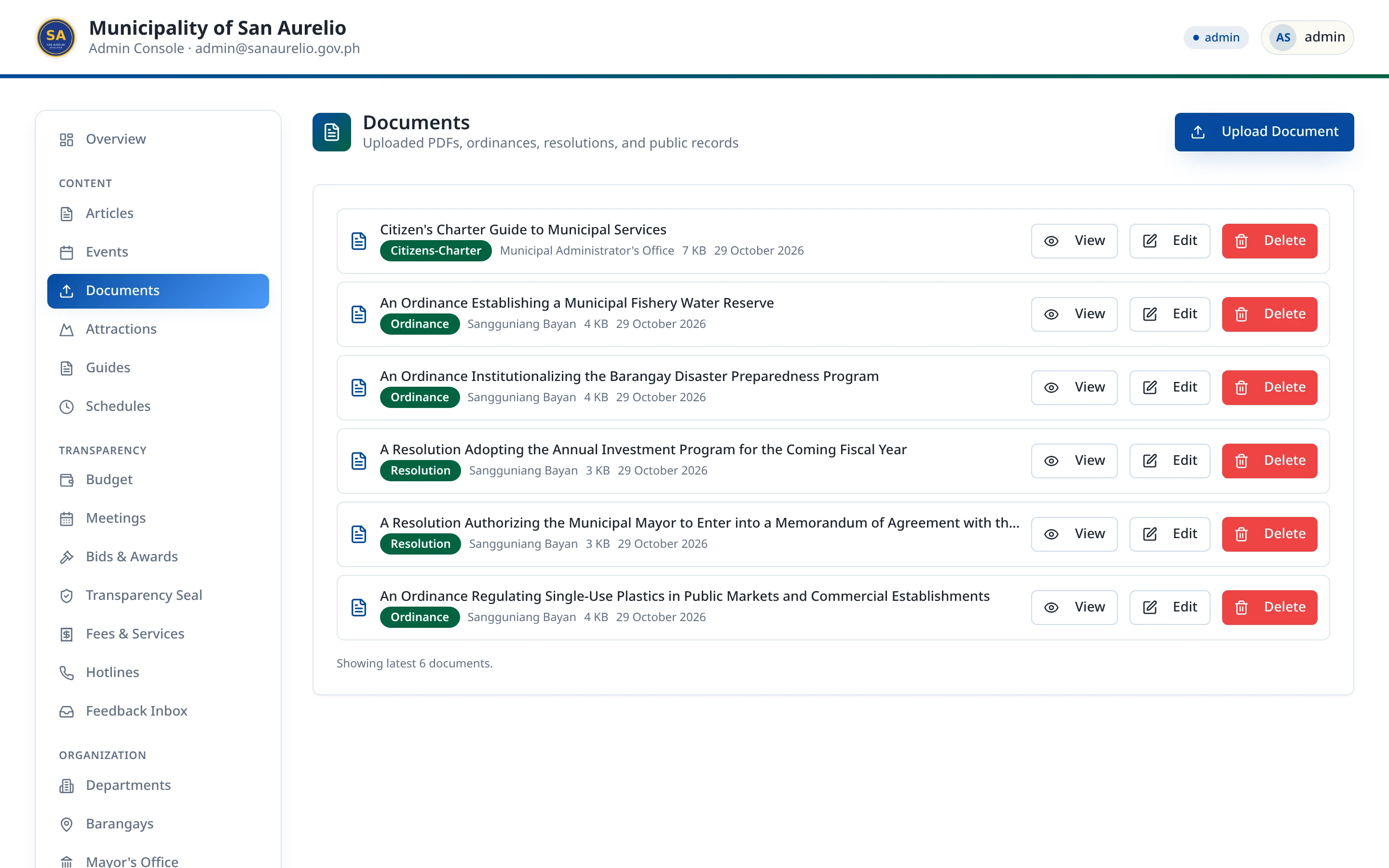
The staff side
The library only stays current if staff can update it. That means a CMS where a staff member uploads an ordinance or resolution, sets the category and year, and publishes it. The public library updates without a deploy.
The same console can carry the rest of the site: articles, events, budget, meetings, and feedback. Service hours, offices, and hotlines should be editable content, not hardcoded pages. The point is not to give staff a page builder. It is to remove the developer from routine content changes.
What this changes
When the library is real, the website stops being a poster and becomes a service. Residents can find the ordinance, the budget, or the bid document. Staff can answer "where is it?" with a link. The site earns its place in the workflow.
The screens on the Municipal website page use seeded demo content, not a client's records. The public library and the staff console are two halves of the same feature.