
A working demo used to be the hard part. Now it is often the easy part. An AI assistant can produce a plausible screen, a script, or a small service in minutes. That changes the cost of writing code. It does not change the cost of owning a system that has to keep working after the demo.
The gap between the two is where most small automation projects succeed or fail. It is also the part that is hardest to see when you are evaluating a builder.
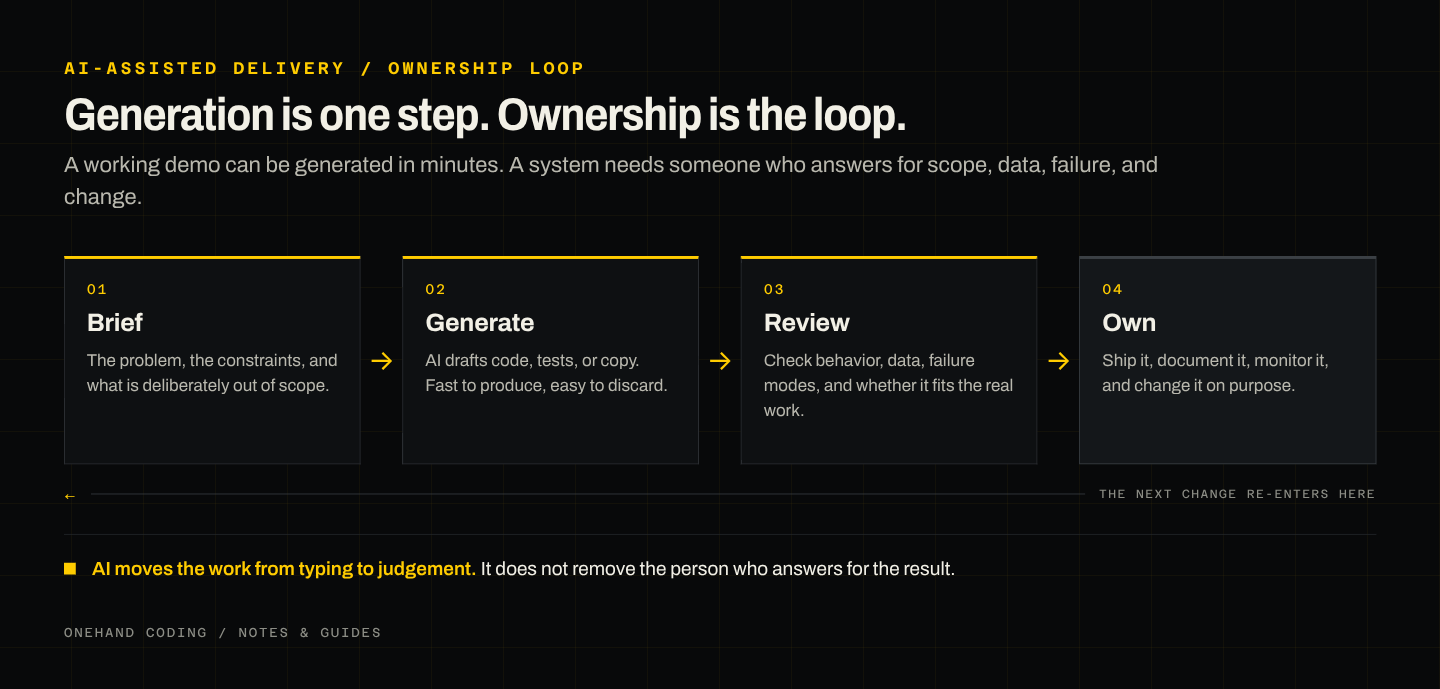
The demo is not the system
A demo runs on the builder's machine, with sample data, for a few minutes. A system runs on someone else's machine, with real data, on a bad day, months later. The difference is not the amount of code. It is everything around the code:
- Where the data comes from, and what happens when it is wrong.
- Who can log in, and what they are allowed to do.
- What the system does when a service it depends on goes down.
- How a change is tested before it reaches real users.
- Who gets the alert when something breaks at night.
AI can help with each of those. It cannot decide them for you.
Ownership is a set of decisions
To own a system is to be answerable for it. That means making decisions and living with the consequences. Four decisions matter more than the code:
Scope. What is the system supposed to do, and what is it deliberately not doing? A clear boundary is the cheapest form of risk control. Without it, every request becomes a change, and every change becomes a regression.
Data. Where does the data live, who can see it, how long is it kept, and how is it backed up? These are not technical details to settle later. They decide whether the system is safe to use at all.
Failure. What happens when the API times out, the file is malformed, or the scheduled job does not run? A demo hides these cases. A system has to handle them or fail in a way someone can diagnose.
Change. Who can modify the system, and how do they know they did not break it? A system without a change path is a system that decays quietly.
None of this requires a large team. It requires someone who will answer for the result.
AI moves the work, it does not remove it
When code is cheap, the expensive parts become specification and verification. You have to describe what you want clearly enough to be built, and you have to check that what came back is correct. Both are judgment work.
This is why a fast builder can still ship a slow project. If nobody owns the decisions, the code accumulates. Each addition looks reasonable on its own. Together they become a system that nobody can explain, and a system nobody can explain is a system nobody can safely change.
The useful shift is not from human code to AI code. It is from typing to reviewing. The builder spends less time writing boilerplate and more time deciding what the system should do, what it must never do, and how to prove it behaves.
What to ask when you hire
If you are evaluating a builder, the interesting questions are not about which AI tools they use. They are about ownership:
- Can you describe the system in plain language without opening the code?
- What happens when the main data source is unavailable?
- How will I know the system is broken before my customers do?
- What is the process for changing it after launch?
- What did you deliberately leave out, and why?
A builder who can answer these questions has a system. A builder who can only demonstrate features has a demo.
The question is not who writes the code
AI will keep getting better at producing code. That is useful, and it is not the bottleneck for most small businesses. The bottleneck is finding someone who will take responsibility for the whole thing: the scope, the data, the failure modes, and the maintenance.
Code is now easy to generate. Ownership is still the scarce part. Hire for that.